GLASS HULL · PROOF POSIT PP-006
Robinhood Chain Failed Transactions: Nearly One in Five Fails, and Still Pays
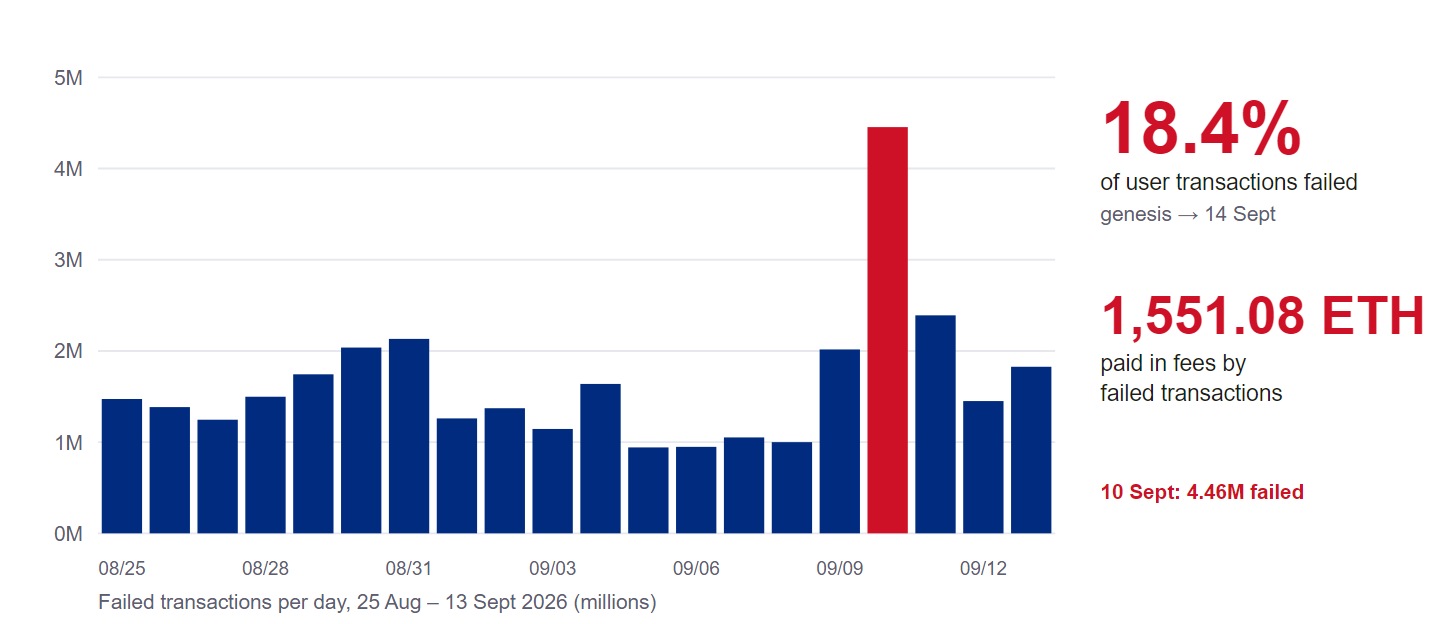
From the chain's first block to 14 September 2026, 119,984,049 of 653,008,422 user transactions on Robinhood Chain failed. That is 18.4%, nearly one in five. Together they paid about 1,551 ETH in gas fees for work that did not go through.
The finding
Glass Hull read every user transaction on Robinhood Chain from genesis to block 62,471,946 (14 September 2026, 03:00 UTC). 119,984,049 failed out of 653,008,422: 18.374%. Those failed transactions still paid about 1,551.08 ETH in fees.
The figures were measured by two independent methods, which agree to the transaction and to the wei, and sealed as Proof Posit PP-006: two hardware signatures and a Bitcoin anchor. The complete method behind it, Full Proof FP-006, is free.
Why a failed transaction still pays gas
On Robinhood Chain, as on Ethereum and every chain built on Arbitrum's technology, a transaction that fails is not free. The network does the work of running it until the point where it reverts, and the gas used for that work is charged. The trade, transfer or mint does not happen; the fee does.
That makes failures a real cost to whoever sends them, and a real source of fee revenue for the chain, whether or not the sender notices.
Who pays? The Robinhood Wallet subsidy
You may have read that transactions from Robinhood Wallet are free. On the chain, they aren't. Robinhood's promotion covers network fees on eligible swaps in its own wallet; every transaction on the chain still pays gas. Robinhood's published terms now extend that coverage to 31 December 2026. So for many retail users, a failed swap costs them nothing directly, and the fee is paid on their behalf.
The day failures spiked: 10 September
Failures are not evenly spread. On 10 September 2026, more than a third of user transactions failed. Most of that came in two evening hours. Five contracts that were active only that day, three of them created that day, each failing almost every call, account for close to 40% of it. Then they went quiet.
The record shows what failed and when. It does not show who ran those contracts, or why.
What this finding does not say
- It does not say why any transaction failed. A failure can be a slippage limit doing its job, a bot's probe, a bug, or a race lost to another trader.
- It does not say who sent the failed transactions, or who paid their fees when a subsidy applied.
- It does not say whether any party acted improperly. It counts; it does not accuse.
Robinhood Chain failed transactions: the questions, answered
How many Robinhood Chain transactions fail?
From genesis to 14 September 2026, 119,984,049 of 653,008,422 user transactions failed: 18.374%, nearly one in five (Proof Posit PP-006).
Do failed transactions on Robinhood Chain pay gas fees?
Yes. A failed transaction is charged for the work done before it reverted. Across the window, failed user transactions paid about 1,551.08 ETH in fees.
Are Robinhood Chain transactions free?
No. Every transaction on the chain pays gas. Robinhood's promotion covers network fees on eligible Robinhood Wallet swaps, now through 31 December 2026, so some users do not pay those fees directly.
When did Robinhood Chain failures spike?
On 10 September 2026 more than a third of user transactions failed, most within two evening hours. Five contracts active only that day account for close to 40% of those failures.
How can I check this myself?
Verify the seal of PP-006 at gh.jetfyul.com/verify, then download Full Proof FP-006, which is free: the queries word for word, both measurements, and the steps to reproduce every figure from any copy of the chain.
Read the proof
Proof Posit PP-006 · Full Proof FP-006 (free) · The Evidence Room · Robinhood Chain Outage: Conclusive Findings
Method: Phillips, SSRN 7444779, SSRN 7444679, The Four Behaviors, SSRN 7365818. Glass Hull holds no tokens and takes no position in anything it measures. Research, not investment advice.