Robinhood Chain Outage: Conclusive Findings
The Chain That Never Stopped, and the Claims That Did Not
A measured account of Robinhood Chain, from its own record: the "outage" that wasn't, free swaps no one noticed, AMC at 73 times its stock price, the first hour that decides a launch, and what we can't yet say publicly.
The findings at a glance
| What was said | What the record shows |
|---|---|
| Robinhood Chain halted for about 14 minutes on 4 Sept from ~12:57 UTC | It never stopped. Posting to Ethereum paused twice, 12:29–12:48 UTC, 14 minutes in total. |
| Wallet fee coverage ends 29 September | Robinhood's terms now run it to 31 December 2026. |
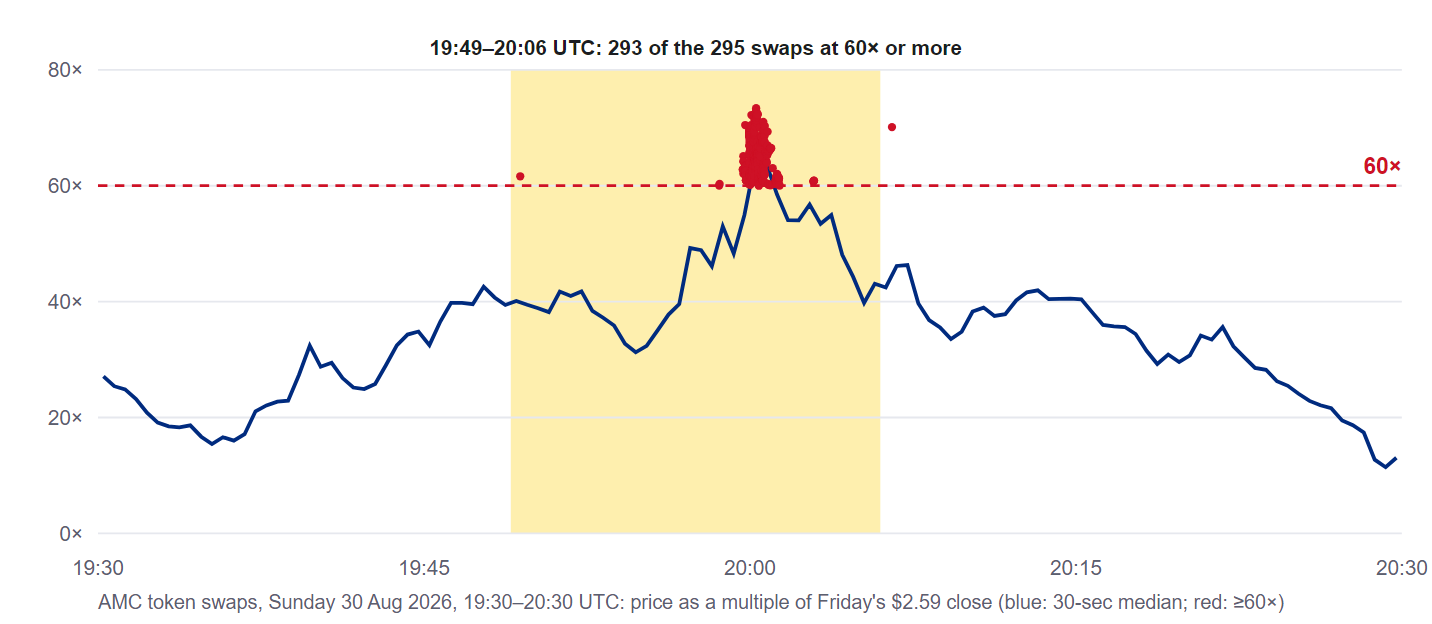
| AMC's token "apparently" traded at 60× the stock | 295 swaps did, 293 of them in one 17-minute Sunday window (max 73.4×). That Sunday, the typical AMC token trade was 10.2× the stock's close. |
| Pons directs 80% of fees to buybacks | Measured to 6 Sept: 47.60% overall, 6.8% in the final two weeks. |
| Pools.trade pays creators 20% | It pays 40.00% of native fees. |
| Stock tokens are never minted or burned on weekends | Confirmed. Zero on every Saturday and Sunday. |
| Robinhood Wallet transactions on the chain are free | Every transaction pays gas on-chain. 18.4% of user transactions fail, and still pay. |
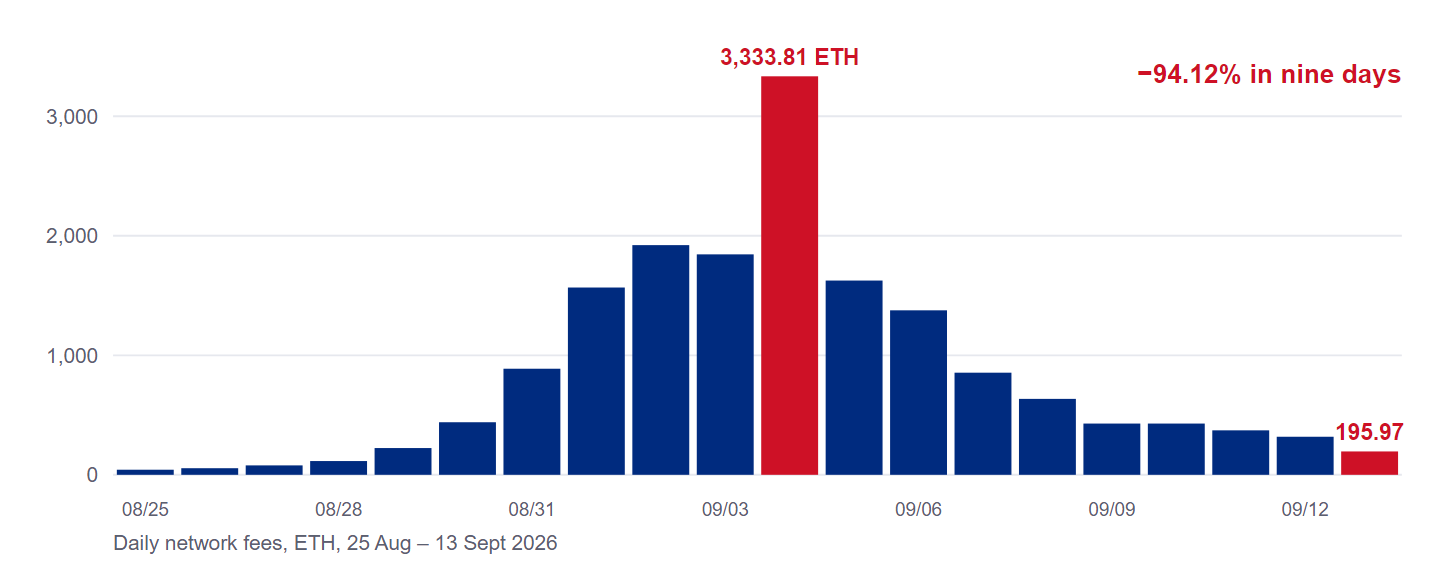
| Fees fell "97%" | 94.12%, from 4 to 13 September, measured to the wei. |
Robinhood Chain did not halt on 4 September. Published reports said it did. The chain's own record says otherwise, and so, it turns out, did Arbitrum on the day.
That gap, between what is said about this chain and what its record shows, is the subject of this piece. Robinhood Chain is the most closely watched experiment in finance right now. Retail traders, developers, fund managers, public companies, regulators and reporters are all forming views about it, mostly from claims no one has checked.
So we checked. Over 24 days and more than 200 hours of measurement sessions, we built our own full copy of the chain's permanent record, measured it, and sealed what we found so it can't be quietly revised. This is what it shows, written for each of you in turn.
What Robinhood Chain is, and what we did
Robinhood Chain is a blockchain Robinhood operates on Arbitrum's technology. It settles to Ethereum, and it opened to the public on 1 July 2026. It carries tokenized stocks, a stablecoin (USDG), token launchpads, and a great deal of trading. Robinhood runs the sequencer, the single machine that orders every transaction.
Everything that happens on it is written to a permanent public record. That record is the only witness that doesn't have a point of view. Everything else, including dashboards, press releases, analyst notes and social posts, is somebody's reading of it.
We read it ourselves. Our measurements cover the chain from its first block to block 62,471,946 (14 September 2026, 03:00 UTC), unless a finding says otherwise. Every figure here was measured by two independent methods, checked against a test designed to catch us if we were wrong, and sealed. How that works, and why it matters, is explained under Our Methodology.
Why this matters
A chain like this lives on trust in claims. "It went down." "It's cheap." "It's backed." "It's full of agents." "Creators earn 20%." Each claim moves money: traders buy or sell on it, builders choose it or don't, companies sue or stay silent over it.
When claims outpace anyone's ability to check them, three things happen. Good news gets discounted, because nobody can prove it. Bad news gets inflated, because nobody can bound it. And the people with the least information, usually the smallest investors, pay for both.
A measured record fixes that for everyone at once. It isn't an opinion to weigh against other opinions. It's the thing the opinions were supposed to be about.
For everyone: the reported Robinhood Chain outage of 4 September
How we found it
On 4 September, reports spread that Robinhood Chain had stopped producing blocks for more than 14 minutes, from around 12:57 UTC. The story fit the moment: a new chain, a trading frenzy, a single operator. We didn't argue with it. We looked.
That day the chain produced 854,255 blocks carrying 13,978,496 transactions. Every one of the day's 1,440 minutes produced at least 548 blocks, and the longest gap between two blocks was 2 seconds. In the minute beginning 12:57 UTC, the chain produced 592 blocks. It was running normally.
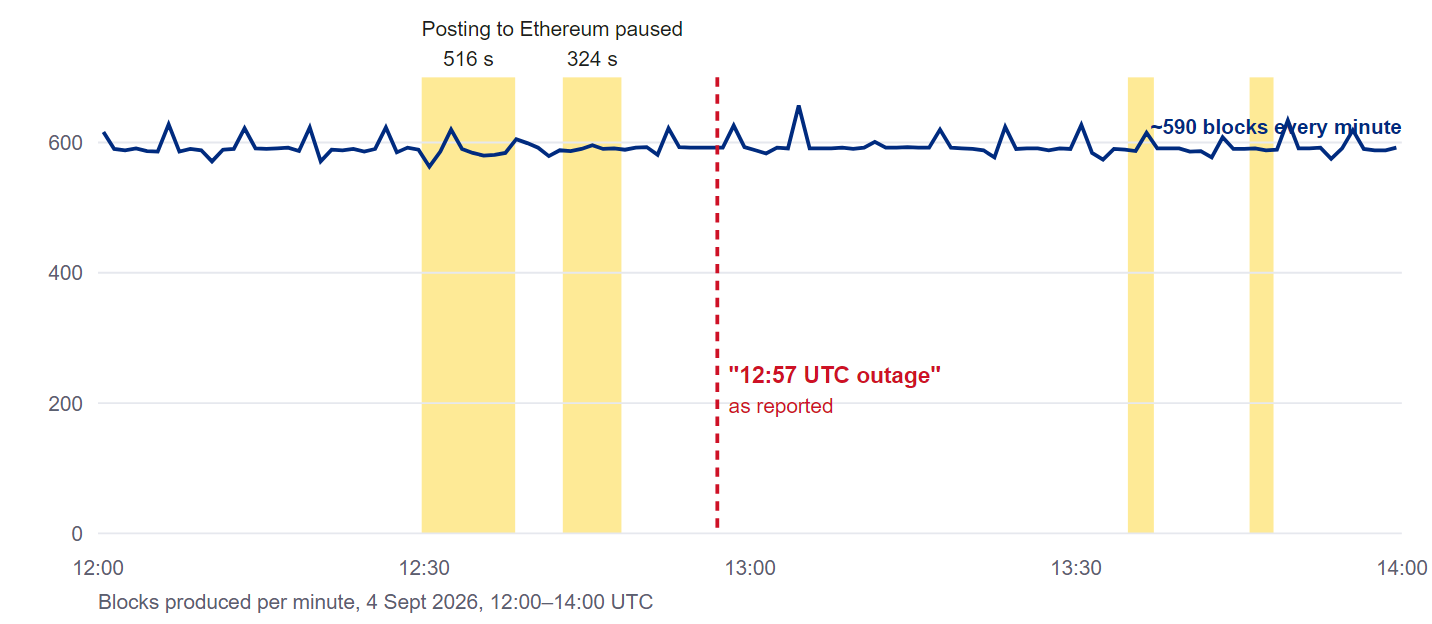
What did stop was something else: the chain's posting of its data to Ethereum. It paused twice, from 12:29:47 to 12:38:23 UTC and from 12:42:47 to 12:48:11 UTC. That's 516 seconds plus 324 seconds, or 840 seconds, exactly 14 minutes. Both pauses ended before the time the reports gave.
Arbitrum said as much that day, in a post on X at 2:19 PM ET: "Robinhood Chain experienced no downtime. Earlier today, Robinhood Chain experienced batch posting delays due to L1 market blob behavior. Direct user transactions experienced no delays." It added that some infrastructure providers relying on the chain's data stream "experienced a brief performance impact due to a high number of feed subscribers."
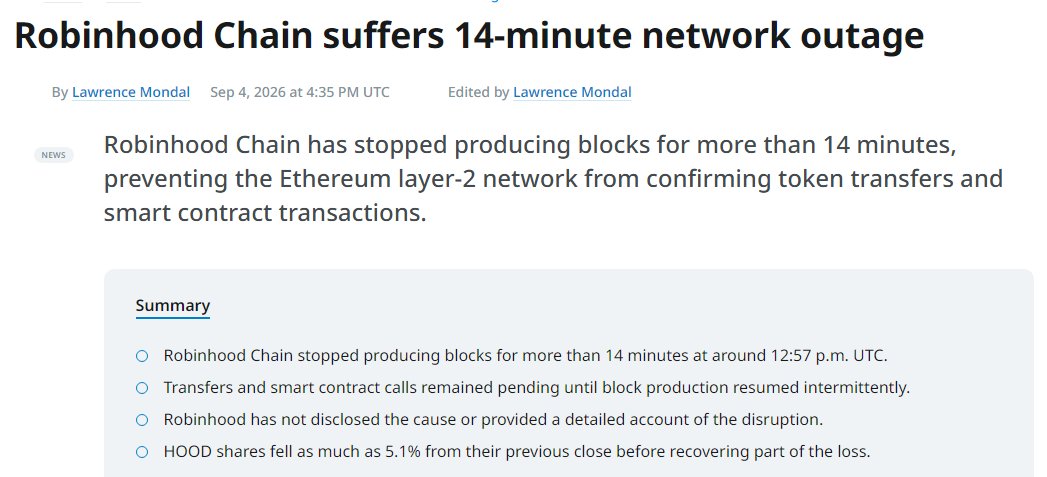
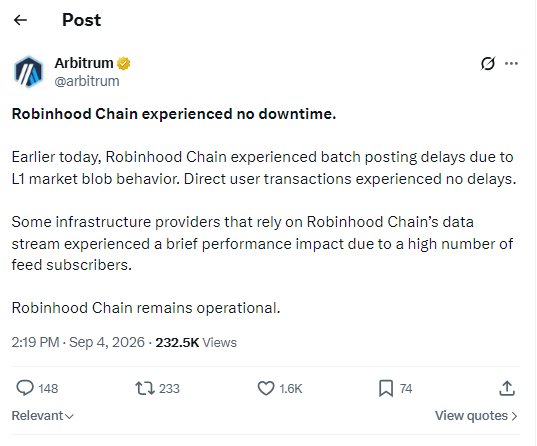
We then went one step further than anyone had, and rebuilt Ethereum's public record for those minutes. In both long pauses, the chain's standing bid for blob space was above the blob base fee Ethereum was charging, by roughly 4 to 13 times in the first and 4.5 to 8.8 times in the second. The first posting after each pause bid higher still. So the base fee alone doesn't explain either pause. Whatever held those postings back isn't visible in the record, because Ethereum only records what gets included, not what was tried and replaced. We don't guess at a cause beyond what the data shows.
Two smaller gaps followed later that afternoon, of 144 and 132 seconds. None of the gaps sits at 12:57 UTC. The Defiant published a careful block-level analysis the same day and got the essential point right, that the chain never stopped; its timestamp for the first gap was off, and in the window it named, 35 posting transactions went through.
What this means for you
- The chain kept producing blocks and including transactions throughout 4 September.
- Since public mainnet opened on 1 July, the chain has never gone more than 16 seconds without a block. That was on launch morning.
- A pause in posting to Ethereum is real, and it matters for anything that depends on final settlement to Ethereum. It is not the chain stopping.
→ See the Proof Posit: PP-005, the chain never halted
The free swaps no one noticed
Every piece of reporting we archived says Robinhood's coverage of network fees for Robinhood Wallet swaps ends on 29 September. Robinhood's own published terms now say otherwise: the offer period runs "to 11:59 PM EST December 31, 2026," and "RHNC may change the Offer Period dates at any time without notice." We archived both versions.
That matters to more than wallet users. Before this change, we had pre-registered a study of what would happen to activity when the coverage ended on 29 September. We sealed the method in advance so we couldn't bend it to the result. The event moved. So we've sealed a notice saying so, we'll carry out the study exactly as registered, and we'll publish the result by 28 October with that change stated up front. A new pre-registration will follow for the new end date. We don't move the goalposts, even when the world does.
Nearly one transaction in five fails, and still pays
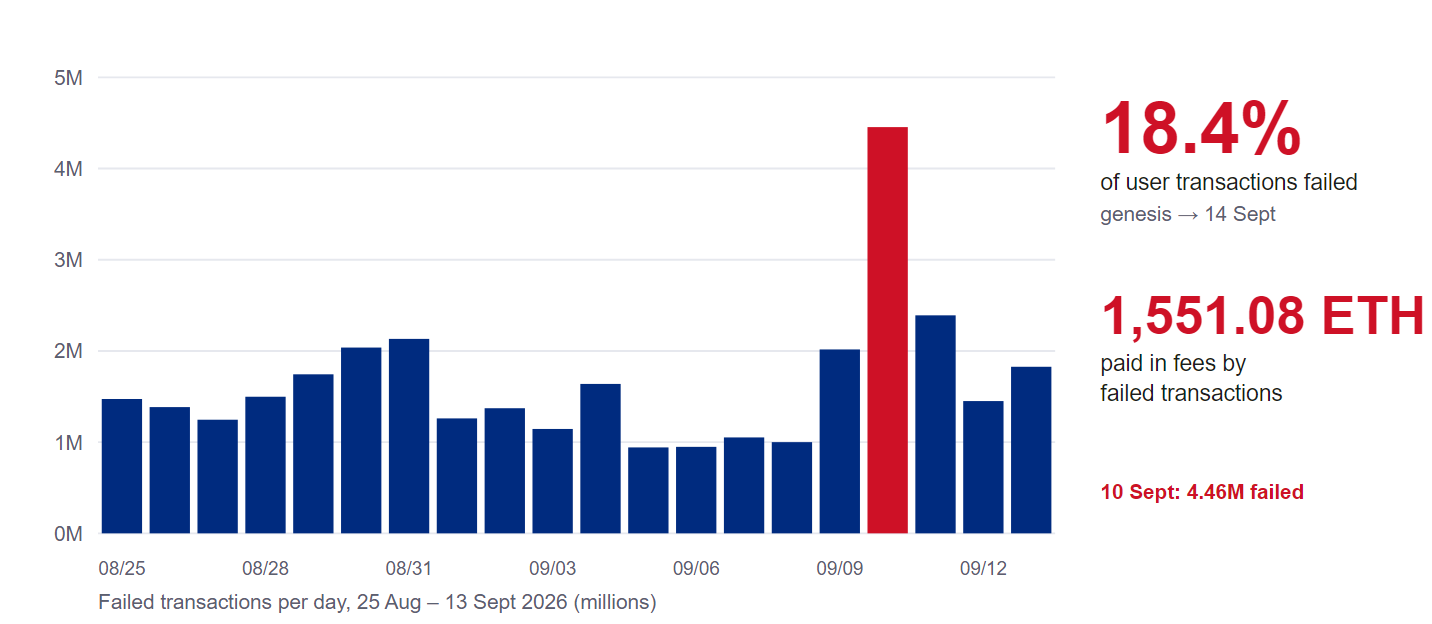
You may have read that transactions from Robinhood Wallet on the chain are free. [crypto.news (archived), CryptoTicker (archived), KuCoin News (archived)] On the chain, they aren't. Robinhood's promotion covers fees on eligible swaps in its own wallet; every transaction on the chain still pays gas. From the chain's first block to 14 September, 119,984,049 of 653,008,422 user transactions failed: 18.4%, nearly one in five. Failed transactions still pay fees. Together they paid about 1,551.08 ETH, computed exactly and confirmed by two independent routes. That's the cost of trading on a busy chain in a hurry, and it's a figure that never appears in anyone's marketing.
→ See the Proof Posit: PP-006, nearly one in five fails
The failures aren't evenly spread. On 10 September, 35.1% of user transactions failed. Most of that came between 18:00 and 20:00 UTC, and five contracts active only that day (three of them created that day), each failing almost every call, account for 38.6% of the day's failures before going quiet at about 19:23 UTC. The record shows what failed and when. It doesn't show who ran those contracts, or why.
For investors and traders
"Apparently 60X": what actually happened to AMC's token
On 4 September, the chief executive of Securitize wrote that AMC's tokenized stock was "apparently" trading at 60 times the real share price. The line traveled. It became part of the argument between AMC and Robinhood. Nobody we could find had measured it.
We did. Across 381 trading pools for AMC's token, there were 386,668 swaps worth about $147.1 million. Of those, 295 swaps executed at 60 times or more above AMC's most recent Nasdaq close. So yes, it happened. And the 60× trades turned out to be the tip of something larger:
- It was essentially one event. 293 of the 295 swaps happened on Sunday 30 August, between 19:49 and 20:06 UTC, a 17-minute window, from 190 different wallets. The stock market was closed. The reference was Friday's close of $2.59.
- The extreme trades were small. Together those swaps came to about $82,700: 1.5% of that day's AMC token volume and 0.056% of all AMC token volume.
- The dislocation was not. Across that whole Sunday, the typical AMC token swap priced AMC at 10.2 times Friday's close. 60% of the day's $5.46 million of AMC token volume traded at 10× or more, and 99% at 2× or more.
- And it was one day. Across the 33 days of AMC token trading we measured, 30 August is the only day with even 1% of its volume at 10× or more. On a typical day, the token traded at about 1.0× the stock. The next-highest day's median was 2.61×, on $17,000 of volume.
- The largest meaningful trade was 73.4×. That was a $496 swap on 30 August at 20:00 UTC. We excluded one higher print because it was a rounding-level trade worth a fraction of a cent.
Two things are true at once. "AMC traded at 60×" describes 17 minutes on one Sunday evening, not a market: that's the correction. But for that entire Sunday, with the stock market closed, AMC's token traded at many times the real stock, all day long, and only that day: that's the warning. Figure 5 shows both. The dislocation holds even on the dollar-paired pools alone, with no conversion involved: a median of 8.4× that day.
→ Proof Posit forthcoming: B4, AMC at 60×
What this means for you
- Before you buy a stock token, check the real share price, especially outside market hours.
- Our daily peg page compares every stock token on the chain with its underlying share, every day, for free: gh.jetfyul.com/verify/peg.
- Stock-token supply never changes on weekends (see below), so weekend price moves are pure trading, not new supply.
Buyback promises, measured
Pons, the chain's largest token launchpad, states in its own documentation that "a manual buyback is running via an automated TWAP using 80% of protocol fees," and notes that the figure is "not immutable yet." Buybacks support a token's price, so holders care about that number.
What the record shows: measured to 6 September (block 55,927,945), the share of protocol fees actually spent on buybacks is 47.60%. Over the most recent two weeks, it is 6.8%. Pons says the figure can change, and it has. The gap between a stated policy and a realized one is exactly the kind of thing a holder should be able to see, and now can.
Creator payouts, measured
Another launchpad, Pools.trade, is described as paying token creators 20% of fees. [Decrypt (archived); Uniswap (archived)] The record shows creators receive 40.00% of native fees and 0% of token fees. We sealed that finding and anchored it in Bitcoin (block 965,900), and it still holds past our cutoff. For a trader buying launchpad tokens, it's a larger creator take than advertised.
The odds on a new launch
By 6 September (block 55,927,945), there had been 600,601 token launches on the chain. On the largest launch venue, the median token had one holder thirty days after launch. Most launches are, in practice, a creator and nobody else. Only a small fraction ever "graduate" to a real trading pool.
That's not a moral judgment about launchpads. It's the base rate, the number every buyer of a new token should have in mind before they click.
Weekends: supply is frozen
The data provider SQD reported that Robinhood's issuer never mints or burns stock tokens on weekends. Our record agrees: zero issuer mints and zero issuer burns on every Saturday and every Sunday. There is weekend activity, and it's transfers to a "dead" address: 884 on Saturdays and 2,929 on Sundays. That's a different operation, and we report it separately.
The fee collapse
Daily fees fell from 3,333.81 ETH on 4 September to 195.97 ETH on 13 September, a 94.12% decline, measured two ways that agree to the wei. Reports put it at 97%. Either way, the frenzy cooled fast, and it happened before any change to fee coverage.
The "7% APY," decomposed
Robinhood advertises that you can "earn an estimated 7% APY" on USDG through Robinhood Earn. [Robinhood Earn (archived)] The lending runs through Morpho, and part of the return comes from a separate rewards program, Merkl. On 23 September, the programs' own data put the 7% at about 4.0 points of organic lending and 3.0 points of subsidy. Roughly 43% of the headline is subsidy, paid in extra vault shares. On-chain, the last full week we measured showed 3.72% organic and 1.50% of subsidy actually claimed. Claiming lags earning, so that figure understates the subsidy.
Subsidies end. The organic 4% is the part that belongs to the market.

What happens when the market reopens
Stock tokens trade seven days a week; the stocks they track don't. So what happens on Monday morning? Across 11 weekends and 193 stock tokens, the worst Monday gap was AAOI on 24 August: −12.6% on Nasdaq and −16.9% on-chain. That's inside the 20% adverse gap that Longbow's own risk model is reported to be built to absorb. [Longbow (archived); Bakas Media (archived)]
Did the weekend risk cascade into forced selling? It didn't. Across 225 lending markets, stock-token collateral saw just 4 liquidations, none in the Monday-open window, and zero bad debt.
Are bots eating your trades?
Sandwich attacks, in which a bot trades just ahead of you and just behind you, are a real fear on public chains. On Robinhood Chain, they're at noise level. Our search flagged 276 candidates, but it flags 122 even when the order is reversed, which is its false-positive baseline. The candidates touched 241 swaps, 0.0005% of all swaps, with about $30,000 of volume and $3,464 in gross gain to the attackers. Arbitrage, properly defined, came to 190,711 transactions (0.73% of swaps) and $1.00 million in profit. First-come, first-served ordering appears to be doing its job for ordinary traders.
For developers and founders
The Hull Against the Machine
Measuring what happened is half of what we do. The other half is saying what will happen, before it does, and letting the record judge us. That's The Hull Against the Machine, our prediction series. We seal each prediction before the event, sign it with two hardware notaries, anchor it in Bitcoin, and reveal it on a timer. The scoreboard shows our misses as plainly as our hits.
Our first event moved. Robinhood extended its fee coverage to 31 December, so the predictions we'd readied for 29 September now attach to the new date. If you're game, take us on: log your own call before ours is revealed at gh.jetfyul.com/hull-against-the-machine.
Which brings us to the most predictive thing we found.
The first hour decides a launch
This is the finding I find most remarkable. We asked whether a token's first hour on the chain predicts whether it will graduate. We trained a model on launches from 3 August to 4 September and tested it on launches that came after. We used only information available within each token's first hour, and dropped any token that had already graduated by then. Measured against how rarely launches succeed, the result is astounding.
The result: using nothing but the first hour, the model ranks eventual graduates above failures with an accuracy score (AUC) of 0.975. Of the top 1% of launches it flags, 14.8% graduate, against a base rate of 0.22%: roughly 67 times the odds. That top 1% contains 68.7% of all graduates.
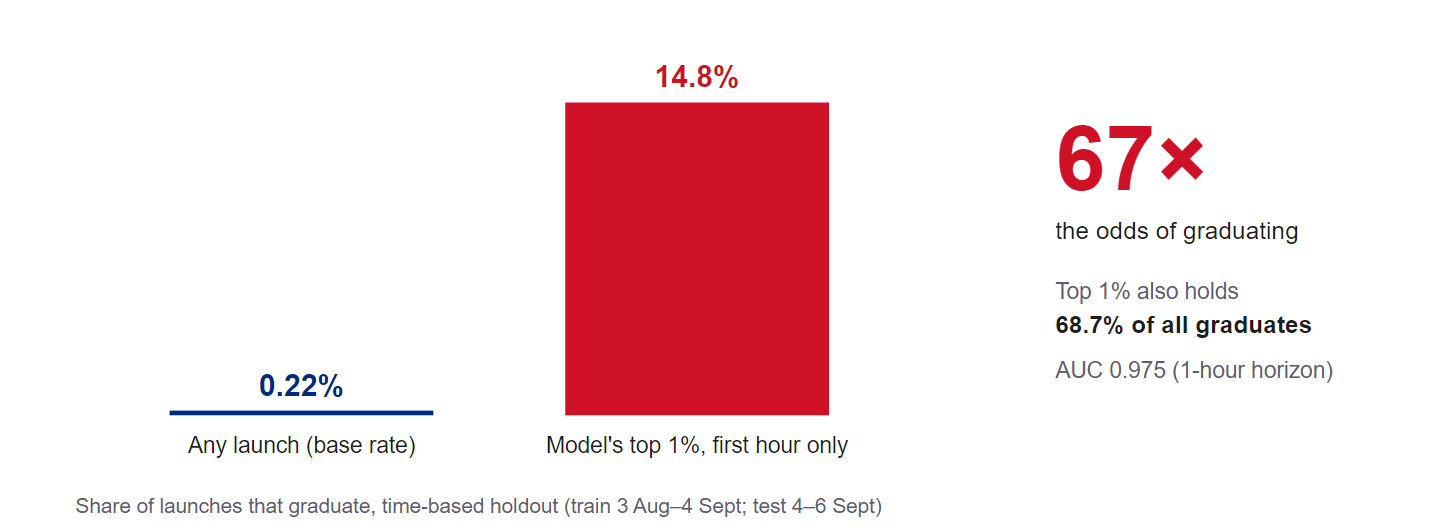
A second fact came out of it. By hour six, only 18 graduates were left to predict. By day one, none. On this chain, graduation is decided almost immediately.
What this means for you
- If you're launching, the first hour is the whole game. The record shows what successful launches do in it. And yes, if you are a developer, that should excite you immensely: of all the extractions in this report, this is the one I envy as a non-participant. You can learn more here.
- 85% of even the top picks still fail. This narrows the field; it guarantees nothing.
- Our test window was short (about 50 hours, including the 4 September spike). We will re-test on later launches and publish the result either way.
→ Proof Posit forthcoming: B11, the first hour
Accounts, agents and who pays for gas
Robinhood has reported that nearly 100,000 customers opened "agentic trading" accounts. That's a brokerage figure. On the chain itself, we counted 266,239 distinct smart accounts (programmable wallets), which have submitted 3.17 million user operations. Sponsors known as paymasters covered the gas on 27.5% of them. The two numbers measure different things, and we don't set one against the other. For builders, the on-chain count is the one that describes your addressable users.
→ Proof Posit forthcoming: B6, smart accounts
Reliability, and who controls ordering
Block production has been steady: never more than 16 seconds without a block since launch. But understand what you're building on. Robinhood's terms disclaim any guarantee of sequencer uptime. [Robinhood Chain Terms of Service (archived)] Transactions are ordered first come, first served. The sequencer screens transactions, and independent reviewers note there is no guaranteed path for a transaction to be included if the sequencer won't include it. [L2BEAT (archived); Robinhood Chain docs (archived)] Whatever the intentions, the design puts ordering in one operator's hands. Design for that.
Who is actually trading
CoinDesk Research estimated that Robinhood's own app users accounted, at their peak, for about 1–2% of the chain's transactions. [CoinDesk Research (archived)] The record can't confirm or refute that, and we won't pretend otherwise. What it does show is that none of the 31 largest routers, which together carry 83.8% of 53.1 million stock-token swaps, ties to Robinhood through anything in the record: not its stock-token issuer, its token factory, that factory's deployer, or its custody wallets. The single largest router carries 33.6% and is unattributed. Unattributed isn't the same as third-party, and that's all we can state on that. Stock tokens were 16.3% of USDG trading volume on Uniswap V4 across our window, and 19.5% and 17.5% in the last two full weeks.
→ Proof Posit forthcoming: B3 and B8a, who is trading
$18 billion that never moved
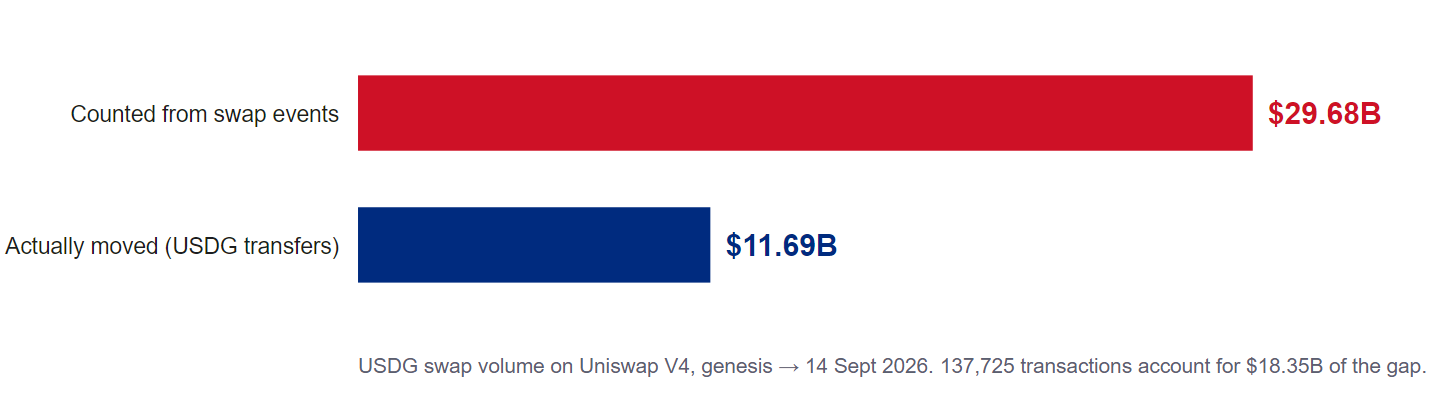
If you build dashboards, this one is for you. Counting swap events at face value, the chain shows $29.68 billion of USDG swap volume. The USDG that actually moved was $11.69 billion. 137,725 transactions account for $18.35 billion of the difference: swap records inside Uniswap V4 that report enormous amounts while almost nothing is transferred. In two transactions alone, swap events claim $17.19 billion while about $0.0001 changed hands. The takeaway: measure what moves, not what an event says. We found no published volume figure that matches either measure, so we attribute this to no one.
→ Proof Posit forthcoming: phantom volume
The cost of failure
An 18.4% failure rate, paid in fees, is a design problem with a design solution: better gas estimation, simulation before submission, and sensible retry logic. On this chain, at this scale, those choices are worth real money that, as a user, you can take to the bank. For the full cost, see our failed-transaction finding.
For companies and organizations
Arbitrum's 10%, reconciled
Under the Arbitrum Expansion Program, chains like this one owe Arbitrum a share of their revenue. Analysts have estimated the split at roughly 90% kept, 10% to Arbitrum and under 1% to Ethereum, and a Standard Chartered estimate, reported by CoinDesk, put Arbitrum's total monthly revenue run-rate at about $5 million. [The Block (archived); CoinDesk (archived)] No independent audit of those payments has been published.
We measured every settlement. Each one split exactly 90/10, to the wei. That record is sealed and public (Proof Posit PP-003). The first independent reconciliation of what was collected, what was owed and what was remitted follows shortly as PP-004.
→ See the Proof Posit: PP-003, AEP payments
Backing: what the chain can and cannot show
Robinhood now represents its stock tokens as backed one-for-one, held with a US-licensed custodian, with collateral monitored daily. The chain can show us supply. We confirmed stock-token supply agrees between two independent measurements for every one of the 193 tokens with supply on the chain (measured to block 57,818,813). It cannot show us a custodian's vault.
Robinhood has also said in-kind redemption and voting rights "are coming." [Vlad Tenev on X; BeInCrypto (archived)] Until they arrive, a stock token is exposure to a share, not a share.
The anomalies
We found anomalies. Their full findings are held under notice for the parties they concern. Publication of findings never depends on any purchase. Here is what I will say publicly.
What we followed, step by step
- It starts at a multi-signature safe that needs three of its four owners to act. Three of them cancelled a transaction and, 39 seconds later, signed a replacement.
- 49 seconds after that, a single key paid for the next account in line to act.
- The path ends at an account created fresh: it had sent nothing before it was funded.
- On 4 September that new account received 35 stock tokens, each minted earlier the same day. Tokenized AMC shares arrived the next day, after AMC's last mint.
- One high-volume account fed the path: 418 token transfers to its final account and 615 to the account before it.
What the record does not show: who holds any key, or why any of it was done. No finding alleges conduct by any issuer. The full trace, with every identifier, is in its Full Proof.
The parties concerned: Robinhood Chain; the Arbitrum Foundation; and the 70 issuers whose tokenized instruments the traced account held, AMC Entertainment among them, each named in the Gated Proof Posit for this finding, reserved for parties of interest: gh.jetfyul.com/gated-proof-posits.
No finding here alleges conduct by any issuer. Their instruments appear in the record and therefore have a vested interest, whether they chose to associate their securities with Robinhood or not. All parties named are extended the same opportunity to know what the record shows beforehand. Lastly, if we do decide to share any such anomalies, we think it is equitable that the parties concerned, particularly the subject of such a finding, at a minimum be extended the same amount of time it took us to reach a conclusion. What they do and what we do beyond that timeframe, neither is beholden to the other, nor can I speak for the interested parties or what they may do before or after. We sell data and publish findings at our choosing, as responsibly as the implications warrant. A professional courtesy is one thing, adherence to values is another; we're coming from the latter. With that stated, each of these parties may license the complete Full Proof. Anyone else with a direct interest may apply to contact@jetfyul.com.
→ See the Gated Proof Posit (parties of interest)
Our Methodology
I'd be remiss not to explain, simply, why our measurements are proofs and not opinions with numbers attached.
It starts before we measure anything: we seal the task
Before a single number is computed, we write down the question and the exact method we'll use to answer it, then lock it with a cryptographic fingerprint and a timestamp. The easiest way to be wrong without looking wrong is to change the question after you've seen the answer. A sealed task is a sealed envelope. When we open the result, anyone can check that we answered the question we asked, not a friendlier one. It's the same logic by which pre-registration protects research from itself.
Two workers do the same job, and neither knows what the other found
Picture this. I dye one worker with methylene blue and another with Red 40. Both are given the identical sealed task. The blue worker reads the chain one way, and the red worker reads it by an independent route. They don't share notes. If blue and red come back with the same answer, down to the last digit, the answer doesn't depend on one tool, one database or one bug. When they disagree, we don't publish. We find out why. That has happened, and we fixed what it exposed before anything went out.
Why insist on this? In Independence Is a Claim Until It Is a Capability, I set out what a party relying on someone else's measurement can fairly demand of it. The short answer: independence you can't test is only a claim. Two routes that must agree, a test built to catch us, and a method you can re-run are how independence becomes something you can check rather than something you're asked to believe. (Phillips, SSRN 7444779, 2026)
We also run the task backwards. Every finding carries a second test designed to catch us if we're wrong. If we say something didn't happen, we prove our method would have seen it if it had.
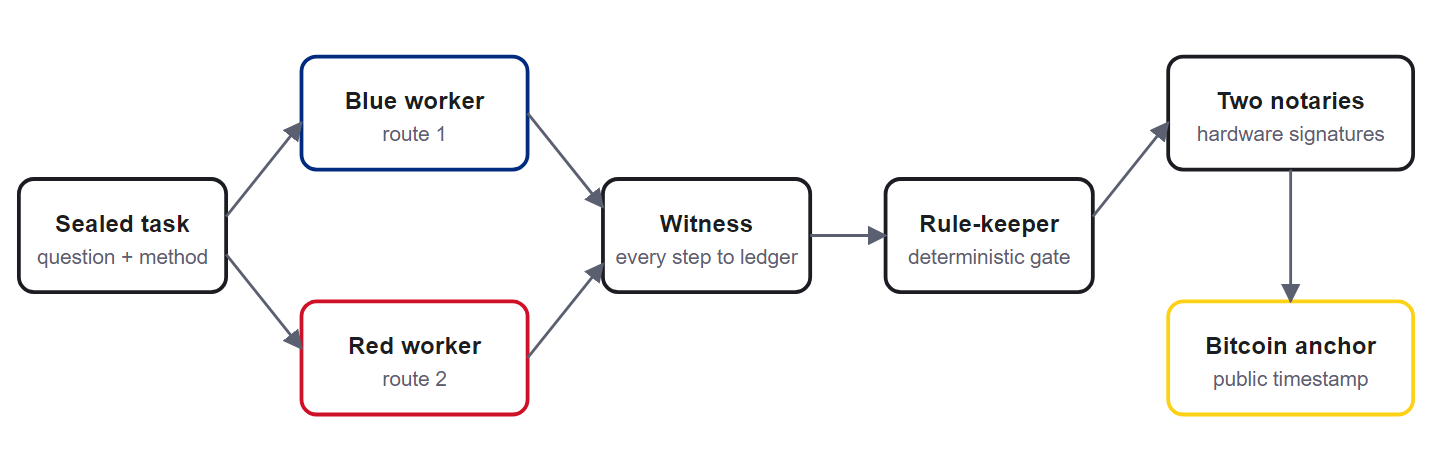
A witness records every move, as it happens
While the workers run, a witness writes each action into a ledger the moment it occurs: what ran, on what data, at what point in the chain, with what result. Nothing is reconstructed afterward from memory. The record is the work.
That idea, that the valuable thing isn't the automated work but the proof of what the automation did, is the subject of The Proof Layer. There I argue that the next contest in automated systems isn't over access, but over whether permission, refusal and behavior can be proved. Our witness, our gate and our notaries are that argument, built. (Phillips, SSRN 7444679, 2026)
A rule-keeper, not a person, decides whether a result may be sealed
The finished return goes to a policy gate that follows written rules and nothing else. Same inputs, same decision, every time. It can't be persuaded, rushed or overruled, including by me. It checks that the task was sealed first, that both workers agreed, that the backwards test passed, and that the record is complete. If anything is missing, it refuses.
A rule-keeper matters because disputes over automated activity increasingly turn on the technical boundary: what a system was permitted to do, what it did, and whether its operator can prove the difference. I made that case in The Four Behaviors, on what a serious operator must be able to prove. A gate that can't be talked round is how we meet our own standard. (Phillips, SSRN 7365818, 2026)
Only then do the hardware notaries sign
When the gate approves, it calls two independent hardware notaries: small security chips whose private keys were created inside them and can never be copied out. Each signs the sealed result. Two signatures from two devices mean no single machine, and no single person, can produce a Glass Hull seal alone. The gate then completes the rest, in order:
- The signed result is anchored in the Bitcoin blockchain, a public timestamp nobody controls, not even us.
- It's registered in our ledger, and a public verification page is issued for it.
- It's published with its pinned block and a re-run fingerprint, so anyone with access to the chain can repeat the measurement and reach the same bytes.
Why all of this?
I can only surmise that once we can overcome something, we simply do, and belief is not immune to being overcome. Specifically, anything quantifiable that can be measured. How long a life does belief have left in the business of metrics? The writing is on the wall. Just look at how many beliefs this report has single-handedly dispelled and corrected.
The authorities behind the method
Our approach is set out in three working papers on SSRN:
- K. L. Phillips, Independence Is a Claim Until It Is a Capability: What a Relying Party Can Demand of Any Measurement It Did Not Perform, SSRN 7444779 (11 Sept 2026), ssrn.com/abstract=7444779.
- K. L. Phillips, The Proof Layer: Why the Next Infrastructure Battle is not Over Bot Access, but over Whether Permission, Refusal, and Behavior can be Proved, SSRN 7444679 (11 Sept 2026), ssrn.com/abstract=7444679.
- K. L. Phillips, The Four Behaviors: Why Automation-Risk Litigation Now Turns on the Technical Boundary—and What a Serious Operator Must Be Able to Prove, SSRN 7365818 (28 Aug 2026), ssrn.com/abstract=7365818.
The method draws on established rules for authenticating electronic records, including Federal Rules of Evidence 901(b)(9) (evidence produced by a process shown to give accurate results) and 902(13)–(14) (records of electronic processes and data certified by hash). It also rests on the public standards that make the chain's record readable: Ethereum's blob format for data posting (EIP-4844), the account-abstraction standard behind smart accounts (ERC-4337), native P-256 signature verification (RIP-7212), and OpenTimestamps for Bitcoin anchoring. We build toward the evidentiary standard; we don't claim admissibility for anyone.
How to check us
- Every Proof Posit is free, and each names its window, pinned block and re-run fingerprint.
- The Full Proofs behind the "never halted" and "revenue from failure" findings are free, so anyone with chain access can reproduce them.
- If your bytes differ from ours, kindly let us know publicly or privately. A difference is still a finding.
Robinhood Chain outage: the questions, answered
Did Robinhood Chain have an outage on 4 September 2026?
Not in block production. The chain's own record shows 854,255 new blocks that day, in every one of its 1,440 minutes, never more than 2 seconds apart. What paused was the chain's posting of data to Ethereum, twice, for 14 minutes in total (Proof Posit PP-005).
How long did the reported Robinhood Chain outage last?
Reports described a block production halt of about 14 minutes from around 12:57 UTC. The record shows block production never halted. Posting to Ethereum paused from 12:29:47 to 12:38:23 UTC (516 seconds) and from 12:42:47 to 12:48:11 UTC (324 seconds): 14 minutes in total, both before 12:57.
What caused the posting delays?
Arbitrum attributed them the same day to batch posting delays due to L1 market blob behavior. Ethereum's record shows the chain's bids for blob space exceeded the base fee in both pauses, so the base fee alone does not explain them. Glass Hull states no cause beyond what the data shows.
Were transactions pending or halted during the reported outage?
The chain kept including transactions throughout: in the 12:57 UTC minute named in the reports it produced 592 blocks carrying 5,868 transactions. The chain's record cannot show whether a wallet, front end or explorer was reachable; that is outside what block data records.
Has Robinhood Chain been reliable since launch?
Since public mainnet opened on 1 July 2026, the chain has never gone more than 16 seconds without a block, measured to 14 September 2026 (Proof Posit PP-005).
What is Robinhood Chain?
A layer 2 network built on Arbitrum's technology that settles to Ethereum. It opened to the public on 1 July 2026 and carries tokenized stocks, the USDG stablecoin and token launchpads. Robinhood runs its sequencer, the single machine that orders every transaction.
How can I check these findings myself?
Every sealed Proof Posit carries a fingerprint, two hardware signatures and a Bitcoin anchor, and can be verified at gh.jetfyul.com/verify. The complete methods behind PP-005 and PP-006 are published free, so anyone with chain access can reproduce them.
Limits, and what we won't claim
- What the chain can't show: the chain's record shows what happened on the chain. It doesn't show whether a wallet app or website was reachable, what is in a custodian's vault, or why anyone did anything.
- Our window: figures run to block 62,471,946 (14 September) unless stated. Later activity isn't in these numbers.
- Stock reference prices: these are public closing prices, cited as facts. Dollar values of on-chain amounts use stated exchange rates.
- Where a claim depends on a definition, as with "burns," we state the definition and the result under it.
- Timing: where we couldn't pin a claim's original source, we say so rather than attribute it.
What we're publishing next
- The reconciliation of Arbitrum's share: collected, owed, remitted (PP-004).
- The daily fee series through 16 September, and the result of our pre-registered fee-coverage study by 28 October, with the new pre-registration for 31 December.
- The first-hour launch model, re-tested on later launches, published either way.
- Each finding in this article as its own sealed Proof Posit, as it's sealed.
The last word
Robinhood Chain is a serious piece of financial infrastructure, and it deserves a serious record. Some of what's been said about it is wrong. Some is right. Some is right in a way that changes what it means. The chain never stopped. The fee coverage didn't end. AMC's 60× was seventeen minutes on a Sunday. A token's first hour tells you almost everything.
None of that required anyone to believe us. It required measuring, sealing and publishing the means to check. That's what we'll keep doing, finding by finding, whatever the record says.
K. L. Phillips
CEO, Jet Fyul Dynamics LLC · Glass Hull
contact@jetfyul.com · gh.jetfyul.com · LinkedIn · Medium · SSRN
Media kit
The key findings, figures and sources in one document, for press and organizations. Open the media kit.
Disclosure: Glass Hull holds no tokens and takes no position in anything it measures. We sell Full Proofs, including to parties whose activity we measure, and every buyer receives the same finding. This is research, not investment advice. The drafting of this article was assisted by AI tools under the author's direction; every figure traces to a sealed or banked record.
Sources (archived): Arbitrum statement, 4 Sept 2026 (self-archived, ledger 3133716) · Robinhood fee-coverage terms (web.archive.org/web/20260924195157) · earlier 29 Sept reporting (web.archive.org/web/20260924201611) · crypto.news outage report (web.archive.org/web/20260924200651) · The Defiant, 4 Sept (web.archive.org/web/20260924214259) · SQD (web.archive.org/web/20260924200744) · Stocktwits / CoinDesk, Domingo's "60X" (web.archive.org/web/20260906025915; 20260924200613) · Pons docs, 80% buyback (self-archived, ledger 3140836) · Robinhood Q2 2026 earnings release · The Block, Bernstein note (web.archive.org/web/20260924200829) · CoinDesk Research (web.archive.org/web/20260919141412) · BeInCrypto, Kerbrat (web.archive.org/web/20260924201258) · Arbitrum AEP Terms (web.archive.org/web/20260924201004).